Handheld Laser Welding vs TIG/MIG: 10 Key Differences for Industrial Metal Joining
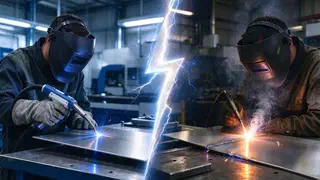
If you’ve been using TIG or MIG welding for years, switching to handheld laser welding feels like a big change. We’ve put together the 10 most important differences based on real production data from our customers.
Comparison Table At A Glance
| Metric | Handheld Laser | Traditional TIG | MIG (GMAW) |
|---|---|---|---|
| Welding Speed | 3× faster | Baseline 1× | 1.5× |
| Post-weld Polishing | Not needed | Required | Heavy polishing |
| Heat Input | Very low | Medium | High |
| Workpiece Deformation | Negligible | Noticeable | Significant |
| Operator Skill Required | Easy (1 week training) | Hard (certified welder) | Medium |
| Hourly Power Cost | ~$0.50 | ~$1.50 | ~$2.00 |
| Consumables Cost / 100 welds | ~$2 | ~$8 (argon) | ~$5 |
| Weld Quality Consistency | Very high | Variable | Variable |
| Equipment Cost | $6,000 – $10,000 | $500 – $1,500 | $300 – $1,000 |
| ROI Timeline | 4 – 8 months | N/A | N/A |
1. Welding Speed — Laser Is 3× Faster
The 3× speed improvement is real and consistent across materials. On 2mm stainless steel:
- Laser welding: 300mm weld in ~10 seconds (30 mm/s)
- TIG welding: 300mm weld in ~30 seconds (10 mm/s)
This means one laser welder can replace two to three TIG stations in a production layout.
2. Zero Post-weld Polishing
This is the single biggest labor saver. Laser welds are:
- Narrow (≤ 1.2mm)
- Clean, no slag
- Uniform appearance
TIG and MIG welds both produce visible weld reinforcement that requires grinding and polishing — adding 30–60% extra time per workpiece.
3. Minimal Heat Input = No Deformation
Low heat input means:
- No warping on thin sheet metal
- No pre-heating required for most applications
- Adjacent materials (paint, coatings) are not affected
For precision parts like battery trays or kitchenware, this eliminates an entire correction step after welding.
4. Operator Skill — 1 Week vs 6 Months
Traditional TIG requires certified welders with 6+ months of training. Laser welding is so forgiving that a new operator can produce production-quality welds after 3–5 days of supervised practice, and be fully independent within a week.
Your skilled welders can move to higher-value tasks like setup and quality control.
5. Power Cost — 3× Lower Per Hour
| Method | Hourly Power Draw | Approx. Cost at $0.10/kWh |
|---|---|---|
| Laser 1500W | 5 kWh | $0.50 |
| TIG 400A | 15 kWh | $1.50 |
| MIG 400A | 20 kWh | $2.00 |
Over 2,000 operating hours per year, laser saves $2,000 – $3,000 in electricity alone.
6. Consumables — Cheaper, Simpler
| Consumable | Laser | TIG | MIG |
|---|---|---|---|
| Shielding Gas | None (wire feeder optional) | Argon (expensive) | Mixed gas |
| Electrode / Tip | 1 copper nozzle ($0.50, 100+ hours) | Tungsten electrode ($2–5 each) | Contact tip ($1 each) |
| Filler Material | Wire only | Wire + gas | Wire + gas |
7. Weld Quality — Machine-Controlled
Laser welds are consistent because the laser power, pulse frequency, and travel speed are all digitally controlled by the machine. With traditional methods, weld quality depends heavily on operator technique and can vary shift to shift.
8. Equipment Cost — Higher Upfront, Lower Total Cost
Laser welders cost $6,000 – $10,000 upfront vs $300 – $1,500 for traditional machines. But the total cost of ownership (including labor, power, consumables, and rework) is 30–50% lower within the first year of use.
Most customers see full ROI in 4–8 months.
9. Portable, No Fume Extraction Required
Handheld laser welders are air-cooled (or water-cooled) and produce minimal smoke. No dedicated fume extraction system is required — unlike TIG/MIG which generate significant welding fumes that must be captured.
10. Works On Materials Traditional Methods Struggle With
Laser welding is particularly effective for:
- Dissimilar metals (steel + aluminum)
- Thin materials (0.5mm – where TIG/MIG cause burn-through)
- Highly reflective metals (copper, brass — requires specific laser parameters)
When NOT to Switch
Laser welding is not perfect for every situation:
- Very thick steel (> 6mm) — need multi-pass welding or automated gantry systems
- Rough / poorly fitted joints — laser needs tight gap control; use TIG for gap filling
- Extremely low-volume one-off work — traditional methods may be more cost-effective
But for high-volume, sheet metal, cosmetic-quality welding, handheld laser is unequivocally the better choice.
Ready to see laser welding in action? Contact us for a free test weld →
