Fiber Laser Cleaner
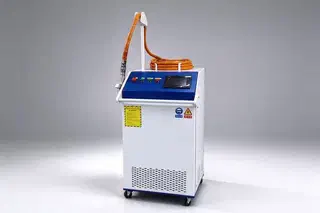
Product Overview
The fiber laser cleaner is a non-contact, green cleaning equipment. It uses high-frequency laser pulses to impact the surface — the light beam rapidly moves, converting into acoustic waves that return from the lower layer, creating resonance with incident waves that breaks down contaminants. Simultaneously, the differential absorption of laser energy between the substrate and surface contaminants causes instant thermal expansion, generating sufficient acceleration to overcome the adsorption force and detach contaminants.
Simple to operate, highly efficient and safe, it is especially advantageous for objects that cannot be moved.
Core Advantages
- Non-contact processing — no substrate damage, no secondary pollution
- Eco-friendly and efficient — no consumables, no chemicals, no dust emissions
- Safe and reliable — modular controls with shielding and safety interlocks
- Simple operation — intuitive touch screen, preset cleaning parameters at one touch
- High efficiency — spot diameter up to 200mm for large-area rapid cleaning
- Wide power range — 1000W / 1500W / 2000W / 3000W / 6000W available
Technical Specifications
| Parameter | Specification |
|---|---|
| Name | Fiber laser cleaner |
| Laser Power | 1000W / 1500W / 2000W / 3000W / 6000W |
| Operating Mode | Continuous / Modulation (Pulse) |
| Laser Wavelength | 1080nm |
| Focus Spot Diameter | 0 – 200 mm |
| Fiber Length | 10 m |
| Cooling System | Water cooling |
| Power Supply | AC 220V / AC 380V |
| Overall Weight | ~ 300 kg |
Working Principle
Laser cleaning operates through two combined effects:
- Resonance Shattering Effect — high-frequency laser impacts the surface; the beam converts to acoustic waves returning from below, creating resonance with incident waves that shatter contaminants
- Thermal Expansion Detachment Effect — substrate and contaminants differentially absorb laser energy, causing instant thermal expansion of contaminants which generates enough acceleration to overcome adsorption forces and detach
Application Industries
- Nuclear power industry
- Shipbuilding
- Tire molds
- Rail transit
- Automotive parts
- High-end machine tools
- Industrial molds
- Steel structure rust removal
- Ancient building restoration
- Precision electronics cleaning
Typical Cleaning Targets
- Rust — oxidation layers and rust on various steel surfaces
- Grease — hydraulic oil, lubricants, heavy oil residues
- Paint — old paint layers, coatings, protective film removal
- Scale — post-heat-treatment oxidation, post-weld scale
- Adhesives — industrial dust, weld spatter, surface attachments
Request a Quote
Tell us your cleaning target, substrate type and area to clean, and we’ll recommend the right power configuration and solution.
